

Why are you still managing four different telco invoices for a communication system that fails whenever the NBN fluctuates? Most Australian business leaders feel the constant friction of juggling separate providers for mobile, data, and office phones while struggling to keep remote teams synchronised. It’s an unnecessary logistical burden that drains your focus and complicates your monthly accounts. Choosing the right unified communications provider Australia relies on is no longer just about securing a phone line; it’s about building a silent engine for your entire business operation.
You deserve a single point of contact that eliminates technical obstacles and empowers your team to perform. This 2026 guide explains how to streamline your connectivity by integrating voice, data, and customer engagement tools into one cohesive platform. We’ll examine the shift toward AI-driven networks and show you how to achieve seamless integration between Microsoft Teams, mobile handsets, and desk phones. By the end, you’ll know exactly how to select a partner that handles the heavy lifting of your infrastructure so you can focus on your core objectives.
Key Takeaways
- Learn why consolidating your NBN, mobile plans, and Hosted PBX under one roof eliminates administrative friction and simplifies your monthly billing.
- Understand the critical criteria for selecting a unified communications provider Australia businesses trust to maintain high call quality and network sovereignty.
- Discover how to bridge the gap between internal collaboration and external customer engagement using tools like Predictive Dialers and Proactive Live Chat.
- Explore the importance of business continuity through 4G/5G mobile backups and local expert support that understands the Australian telecommunications landscape.
- Identify how a streamlined communications infrastructure acts as a silent engine, allowing your team to focus on core objectives rather than troubleshooting connections.
What is a Unified Communications Provider in the Australian Context?
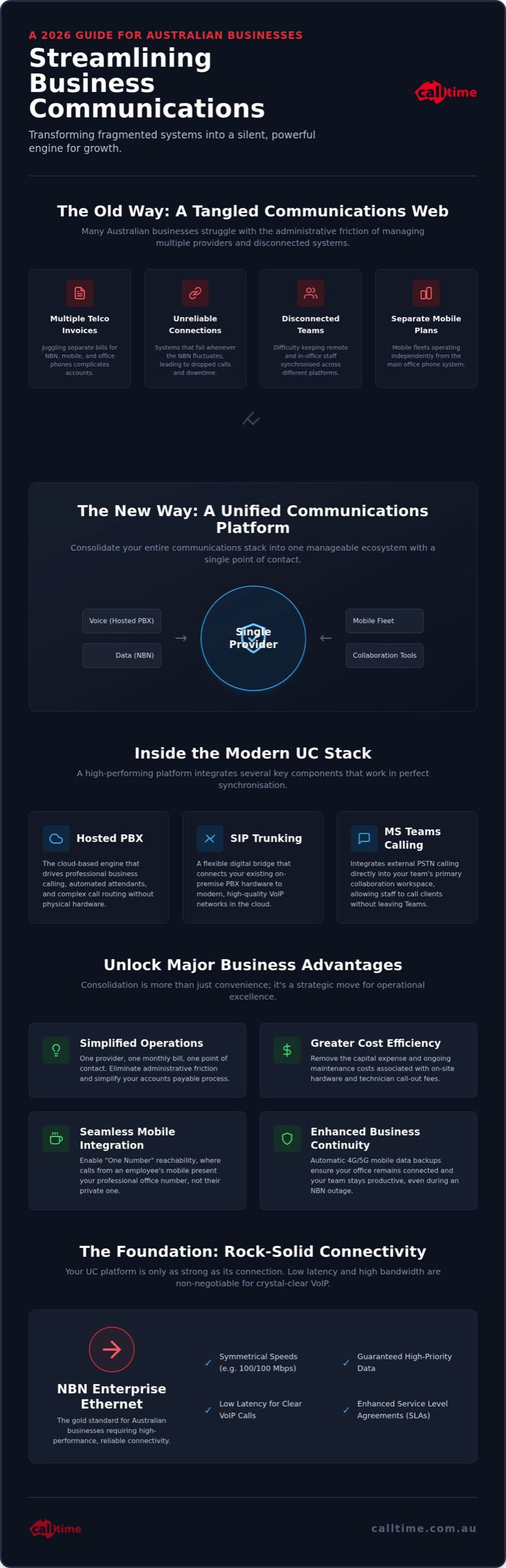
In Australia, the days of juggling separate landlines, mobile accounts, and internal chat apps are over. A unified communications provider Australia businesses partner with acts as a single architect for your entire digital dialogue. By 2026, the transition from fragmented legacy systems to integrated cloud-based “as-a-service” models has become the standard for operational efficiency. This shift isn’t just a technical upgrade; it’s a strategic move to centralise voice, data, and messaging into one manageable ecosystem.
Unified Communications is the strategic integration of voice, data, and messaging into a single interface that removes operational silos and ensures your team stays connected regardless of their physical location.
The total decommissioning of traditional PSTN networks has forced a move toward NBN-backed VoIP. It’s no longer sufficient to simply make a phone call. You need to ensure that voice traffic has the same reliability and security as your core business data. Modern providers now deliver these services through the cloud, allowing for rapid scaling and the removal of expensive on-site hardware maintenance.
The Core Components of a Modern UC Stack
A high-performing UC stack consists of several moving parts that must work in perfect synchronisation. Hosted PBX serves as the virtual switchboard for your business, handling complex call routing and advanced features without the footprint of physical infrastructure. While some competitors suggest that cloud-based systems must replace everything, a knowledgeable unified communications provider Australia relies on knows that many businesses still value their current hardware. This is where SIP Trunking becomes vital, acting as the digital bridge that connects your existing On-Premise PBX to the cloud.
- Hosted PBX: The cloud-based engine that drives professional business calling and automated routing.
- SIP Trunking: A flexible solution for connecting legacy hardware to modern digital voice networks.
- Microsoft Teams Calling: The integration of external PSTN calling directly into your internal collaboration platform, allowing staff to reach clients without leaving their primary workspace.
The Australian Connectivity Factor
Your UC platform is only as strong as the connection it runs on. Low latency is non-negotiable for crystal-clear VoIP; even minor delays can lead to jitter and dropped calls that frustrate clients. In the Australian landscape, the quality of your NBN connection dictates your UC success. For high-demand office environments, NBN Enterprise Ethernet provides the symmetrical speeds and high-priority data traffic required to support a national workforce. It’s the silent engine that keeps your communications fluid and your staff productive.
The Benefits of Consolidating Voice, Data, and Mobile
Managing separate contracts for NBN, office phones, and mobile fleets is an administrative burden that modern businesses can no longer afford. When you partner with a comprehensive unified communications provider Australia trusts, you bring these disparate elements under a single roof. This consolidation does more than just simplify your monthly billing. It ensures your entire communication stack is vertically integrated, meaning your data connection, voice routing, and mobile devices are designed to work as one cohesive unit.
Cost efficiencies are a natural byproduct of this approach. By moving to a cloud-hosted model, you eliminate the need for expensive on-site hardware maintenance and the associated technician call-out fees. Vendor consolidation also provides greater leverage for better service levels. Instead of being bounced between an internet provider and a separate phone company when an issue arises, you have a single point of contact responsible for the entire ecosystem. This accountability is the foundation of a high-performance business environment.
Mobile Fleet Integration
A significant gap in many Australian business strategies is the disconnect between office extensions and mobile handsets. Modern UC solutions bridge this by synchronising Telstra mobile phone plans directly with your Hosted PBX extension. This enables “One Number” reachability; when a staff member makes a call from their mobile, the client sees your professional office number rather than a private mobile digits. It’s an essential tool for maintaining a consistent brand voice across all customer touchpoints. Centralised management tools also allow you to monitor corporate data usage across your entire fleet, preventing the “bill shock” that often occurs with unmanaged mobile accounts.
Operational Resilience
Resilience in 2026 is built on automated redundancy. A true UC platform acts as a silent engine, maintaining your connectivity even when local conditions fail. If a local power outage or hardware failure occurs at your physical office, your cloud-hosted system continues to function. Calls are automatically rerouted to mobile devices or remote laptops without the caller ever knowing there was a problem.
Business continuity is further strengthened through seamless failover protocols. By integrating 4G/5G mobile backups with your primary NBN connection, your office internet stays live even if the physical line is compromised. This level of technical maturity ensures that your staff remain productive and your customers remain engaged. If you are looking to remove the complexity from your infrastructure, it’s worth exploring how integrated communication services can transform your daily operations.
Beyond Internal Chat: Integrating Customer Engagement Tools
Internal collaboration tools keep your team synchronised, but they don’t necessarily drive revenue on their own. To truly scale, your chosen unified communications provider Australia must bridge the gap between internal chat and external customer engagement. This requires moving beyond standard VoIP to include integrated contact centre features. By centralising these tools, you ensure that every interaction, whether via web chat or a phone call, is tracked and optimised for performance.
AI call recording has become a non-negotiable asset for Australian businesses in 2026. It serves two critical purposes: compliance and training. With the ACMA prioritising consumer protection and service reliability in their 2026–27 enforcement agenda, having automated, searchable records of every conversation ensures your business meets regulatory standards. It also allows managers to identify high-performing scripts and coach staff using real-world examples, directly improving conversion rates. This technical implementation leads directly to better business outcomes.
Boosting Call Centre Efficiency
If your sales team spends more time dialling numbers than talking to prospects, your infrastructure is failing you. A Predictive Dialer solves this by using algorithms to dial multiple numbers simultaneously, only connecting agents when a live person answers. This drastically reduces agent idle time and eliminates the frustration of listening to busy signals or answering machines. It’s the silent engine that powers a high-output sales floor.
- CRM Integration: Automatically sync dialer data with your CRM for a 360-degree customer view.
- Automated Compliance: Manage “Do Not Call” registers and regulated calling hours without manual intervention.
- Reduced Abandonment: Optimise dialling rates to ensure an agent is always ready when a customer answers.
Real-Time Website Engagement
Your website is often the first point of contact, but many visitors leave before making an enquiry. Proactive Live Chat changes this dynamic by initiating a conversation based on specific user behaviour, such as time spent on a pricing page. It’s about capturing leads at the moment of highest intent. This proactive approach removes obstacles for the customer and creates a streamlined path to purchase.
Seamless handoff is the key to a professional experience. If a web chat becomes too complex, the agent can trigger a voice call through the Hosted PBX with a single click. This transition feels natural to the customer and prevents a loss of momentum. By using AI to categorise enquiries before they reach a human, you ensure that high-priority leads are routed to your most experienced staff immediately. Efficiency isn’t just about speed; it’s about making every interaction count.
Evaluating Providers: What to Look for in an Australian Partner
Selecting a partner involves more than checking a list of features. A reliable unified communications provider Australia relies on must prioritise network sovereignty. This ensures your data stays in Australian-hosted data centres, which is vital for both speed and compliance with local privacy standards. You also need a support model backed by local experts who understand the nuances of the NBN landscape. Offshore centres often lack the specific context required to troubleshoot local connectivity issues, leading to longer resolution times and increased frustration.
Security is another critical differentiator. Beyond digital encryption, look for a provider that integrates physical infrastructure like CCTV and integrated office security into the UC ecosystem. This holistic approach ensures your premises and your data are protected under one management umbrella. Whether you are a small local office or a national enterprise, your provider must demonstrate the scalability to grow alongside your business without forcing a total system overhaul. It acts as a silent engine that stays efficient as your headcount increases.
Technical Requirements Checklist
Before signing a contract, conduct a thorough audit of your existing environment. Ensure your current NBN speed can handle concurrent voice and high-definition video traffic without jitter. If you aren’t ready for a full cloud transition, verify that the provider’s SIP Trunking is compatible with your existing On-Premise PBX hardware. Finally, confirm that Microsoft Teams calling integration is available. This allows your team to use a single interface for all internal and external communication, which significantly reduces the learning curve for staff.
The Migration Process
The biggest fear for most businesses is the risk of downtime. Professional providers target a “Zero-Downtime” migration by running the new system in parallel with the old one during the transition. This ensures that your business remains reachable at all times. Porting existing Australian business numbers is a delicate process that requires precise coordination. This prevents calls from being lost during the handover. Once the technical switch is complete, staff onboarding is essential. Clear training ensures your team can navigate new communication workflows with confidence from day one.
If you’re ready to upgrade your infrastructure, contact our Australian-based team to discuss a seamless migration strategy that removes technical obstacles.
Conclusion: Calltime as Your National Unified Communications Partner
Streamlining your business connectivity requires more than just a faster internet connection or a new phone app. It’s about a fundamental shift in how your organisation interacts with its staff and its customers. By choosing a unified communications provider Australia businesses can rely on for national coverage, you eliminate the friction caused by disparate systems. Calltime has served as a silent engine for business infrastructure since 2010, providing the technical foundation that allows our clients to focus on their core objectives.
The first step toward transformation is identifying where your current setup is leaking productivity. Many organisations don’t realise the true cost of managing multiple vendors or the impact of poor call quality on customer retention. A comprehensive audit of your current communications will often reveal hidden inefficiencies, from redundant line rentals to underutilised mobile data. Addressing these issues creates a leaner, more responsive business model that is ready to scale.
Why Choose Calltime?
Calltime is a privately owned Australian entity that understands the specific challenges of the local telecommunications landscape. We don’t just offer software; we provide a complete ecosystem that spans from enterprise-grade NBN and Telstra mobile phone plans to advanced tools like Predictive Dialers and Proactive Live Chat. This breadth of service ensures that your internal collaboration and external customer engagement are perfectly aligned. We specialise in tailored solutions for modern enterprises that value efficiency and measurable results.
- Direct access to high-performance Hosted PBX and On-Premise PBX solutions.
- Integrated office security and CCTV to protect physical assets alongside your digital data.
- AI call recording for compliance and performance monitoring across your national team.
- National coverage across Australia with local expert support that understands the NBN landscape.
Start Your Communication Transformation
Moving to a modern Hosted PBX system doesn’t have to be a complex or disruptive process. Our team handles the heavy lifting of migration, ensuring your business stays live and your numbers port correctly without losing calls. By consolidating your telco needs under one roof, you gain a single point of contact and a more resilient infrastructure. It’s time to remove the technical obstacles holding your team back and implement a system that supports your long-term growth.
Organise a consultation with Calltime today to review your current phone and internet setup and discover how a unified strategy can drive your business forward in 2026.
Take Command of Your Business Connectivity
Consolidating your communication stack into a single, high-performance ecosystem is the most effective way to eliminate operational friction. By integrating NBN services with Telstra mobile plans and sophisticated tools like Predictive Dialers, you create a seamless workflow that empowers your staff and delights your customers. Choosing the right unified communications provider Australia relies on ensures your data stays secure in local centres while providing the scalability required for future growth.
Calltime has been a privately owned, Australian-operated partner since 2010. We act as the silent engine behind your infrastructure, providing everything from Hosted PBX to Proactive Live Chat. This technical depth ensures your connectivity just works, allowing you to focus on your core objectives instead of troubleshooting connections. It’s time to remove the technical obstacles holding your organisation back and build a communication strategy that delivers measurable results.
Streamline your business communications with Calltime
Frequently Asked Questions
What is the difference between UC and a standard business phone system?
Unified Communications (UC) goes beyond simple voice calls by merging your Hosted PBX, messaging, and mobile fleets into a single digital ecosystem. While a standard phone system operates in a silo, UC allows your team to switch between a desk phone, mobile app, and video call without losing context. This integration removes technical obstacles and ensures your chosen unified communications provider Australia partner can manage your entire infrastructure through a centralised platform.
Do I need to change my internet plan to use unified communications?
You don’t necessarily need a new plan, but your current NBN connection must handle the increased data load of concurrent voice and video traffic. High latency or low bandwidth will result in jitter and dropped calls, which impacts professional reputation. For high-demand office environments, upgrading to NBN Enterprise Ethernet ensures symmetrical speeds and high-priority data traffic. This provides the stable foundation required for a high-performance communications stack to function as a silent engine.
Can I keep my existing Australian phone numbers when I switch providers?
Yes, you can port your existing Australian business numbers to your new provider to ensure continuity for your clients. This process is managed by your new unified communications provider Australia team to prevent any loss of incoming calls during the transition. Professional providers target a zero-downtime migration by running the new system in parallel with your legacy setup. This coordination ensures your brand remains reachable while you upgrade your underlying infrastructure.
Is unified communications secure for sensitive business data?
Modern UC platforms are highly secure and utilise advanced encryption to protect your voice and data traffic. By partnering with a provider that uses Australian-hosted data centres, you ensure your sensitive information remains subject to local privacy regulations. Security is further enhanced through features like integrated office security and CCTV monitoring. This holistic approach ensures that both your digital communications and physical premises are protected under a single, professionally managed management umbrella.
What is a predictive dialer and does my business need one?
A predictive dialer is an automated tool that dials multiple numbers simultaneously and connects your agents only when a live person answers. This technology significantly reduces agent idle time and eliminates the frustration of listening to busy signals or answering machines. If your business manages a high volume of outbound sales or support calls, this tool is essential for increasing efficiency. It acts as a high-performance engine for your contact centre operations.
How does Microsoft Teams calling work with a UC provider?
Microsoft Teams calling allows you to use the Teams interface as your primary business phone system for external PSTN calls. Your UC provider integrates your Hosted PBX or SIP Trunking directly with Microsoft’s platform, enabling staff to reach clients on any device. This eliminates the need for multiple apps and provides a streamlined user experience. It’s an ideal solution for businesses that already rely on the Microsoft ecosystem for internal collaboration and document sharing.
Can I integrate my Telstra mobile plans into my unified communications system?
Yes, you can synchronise your Telstra mobile phone plans with your office extension to enable “One Number” reachability. This means when a staff member makes an outbound call from their mobile, the recipient sees the professional office number instead of a private mobile number. Centralised management tools also allow you to monitor corporate data usage across your entire fleet. This integration ensures a consistent brand voice while simplifying the administrative burden of managing separate mobile accounts.
What happens to my phone system if the NBN goes down?
If your primary NBN connection fails, a professionally configured UC system will automatically failover to a 4G or 5G mobile backup. This redundancy ensures your office internet and phone lines stay live without manual intervention. Because your system is cloud-hosted, calls can also be instantly rerouted to mobile handsets or remote laptops. This operational resilience protects your business from local power outages or hardware failures, ensuring you never miss a critical customer interaction.