

By 2026, 75% of enterprise telephony buyers will have ditched traditional hardware for a modern hosted phone system. It is a massive shift that signals the end of the expensive, clunky server room setup. You likely already know the frustration of paying high maintenance fees for a system that cannot effectively support your hybrid team or handle NBN congestion without dropping calls. Managing multiple telco bills while trying to scale your operations is a headache no modern business needs.
This guide explains how a high-performance communication platform removes these barriers. You will discover how to transition to a flexible system that eliminates hardware costs and scales instantly with your Australian business. We will look at how to achieve a single, predictable monthly bill and integrate NBN and mobile services for crystal-clear voice quality across every device. This overview provides the roadmap to managing extensions instantly and leveraging new ACMA standards to ensure your communications remain secure, reliable, and entirely professional.
Key Takeaways
- Understand how a hosted phone system replaces legacy copper-wire infrastructure with a managed cloud PBX to eliminate ongoing hardware maintenance costs.
- Discover how advanced features like AI call recording and Microsoft Teams calling turn standard conversations into valuable business intelligence.
- Compare the five-year total cost of ownership between cloud-hosted and on-premise solutions to maximise your long-term communication budget.
- Learn the critical steps for a risk-free migration, including NBN bandwidth audits and seamless number porting for your Australian business.
- Identify the operational benefits of a single-provider strategy that integrates high-speed data, voice, and business mobile services to reduce downtime.
What is a Hosted Phone System and Why Does Your Business Need One?
A hosted phone system is a modern communication platform where your Private Branch Exchange (PBX) is located in a secure data centre rather than on your office wall. Instead of relying on physical copper wires and onsite servers, your voice traffic travels over your NBN connection. This technology allows you to manage calls, voicemails, and advanced features through a web-based interface, effectively turning your entire telephony infrastructure into a managed service. It is the silent engine that keeps a business connected without the clutter of legacy equipment.
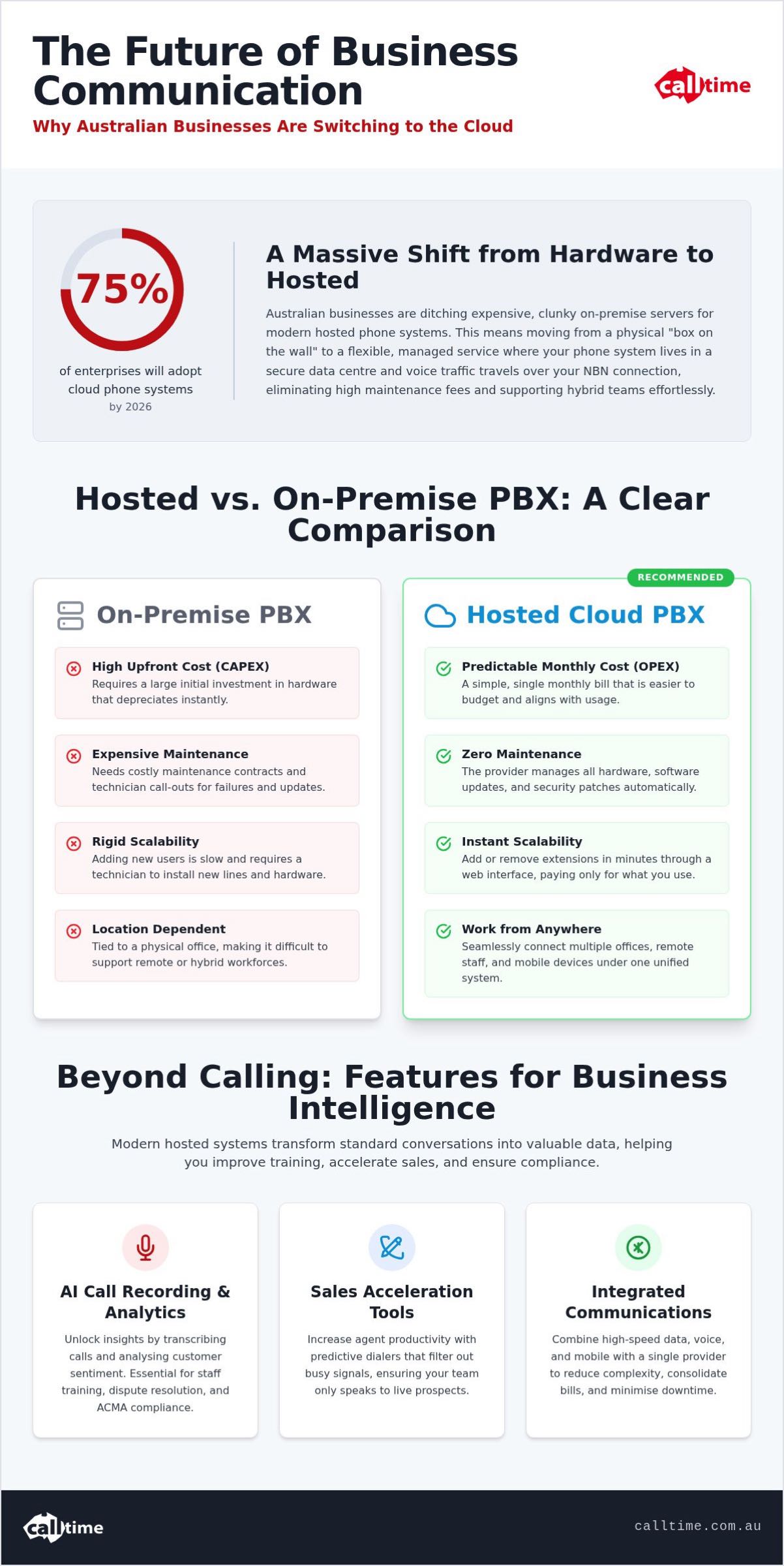
Understanding What is a Hosted PBX requires looking at the shift from ownership to utility. In the past, Australian businesses had to buy, install, and maintain a “box on the wall” that depreciated the moment it was plugged in. Today, that model is obsolete. By 2026, it is projected that 75% of enterprise telephony buyers will choose cloud-based solutions over on-premises hardware. This transition is no longer optional for organisations that want to stay competitive and responsive to a hybrid workforce. Legacy systems simply cannot keep pace with the speed of modern commerce.
The End of the Hardware Headache
Maintaining onsite hardware is a constant drain on resources. Traditional systems require expensive maintenance contracts and even more expensive technician call-outs when things go wrong. A hosted phone system eliminates these obstacles entirely. Since the provider manages the core infrastructure off-site, you never have to worry about hardware failure or manual software patches. Updates happen automatically in the background. This ensures your system is always future-proof and running the latest security protocols without you lifting a finger. It also shifts your financial model from heavy upfront capital expenditure (CAPEX) to a predictable, monthly operating cost (OPEX) that is much easier to balance.
Scalability: Growing Without Growing Pains
Business growth should be exciting, not a technical nightmare. If you hire five new staff members tomorrow, a cloud system allows you to add their extensions in minutes. There’s no need to wait for a technician to run new lines or configure a physical switch. This flexibility is perfect for Australian companies with national footprints. You can support multiple office locations or remote staff under one unified system. If you experience seasonal lulls, you can scale back your requirements just as easily. You only pay for what you use, ensuring your communication costs always align with your actual business size.
Advanced Features: Transforming Calls into Business Intelligence
A modern hosted phone system does far more than simply connect one person to another. It acts as a comprehensive communication suite that captures data at every touchpoint. In a competitive Australian market, the difference between a won lead and a lost opportunity often comes down to how quickly and effectively you respond. By integrating advanced tools directly into your call flow, you can significantly reduce call abandonment and ensure every customer feels heard. To appreciate the scale of this shift, it helps to understand how VoIP technology works as a foundation for these data-rich features.
AI Call Recording and Analytics
AI call recording is a sophisticated tool for unlocking hidden customer data by converting raw audio into searchable, actionable insights. Beyond simply storing files for training, these systems use Artificial Intelligence to transcribe conversations and analyse customer sentiment in real-time. This allows managers to identify frustrated callers before they hang up or pinpoint successful sales scripts that drive conversions. From a regulatory perspective, automated recording is essential for compliance and dispute resolution. With the ACMA announcing in 2026 that it will directly enforce new consumer protection standards, having a transparent, recorded trail of all interactions is a vital safeguard for any local business.
Sales Acceleration: Predictive Dialers and Live Chat
For teams focused on growth, efficiency is the only metric that matters. Implementing predictive dialer software can drastically increase agent talk time by automatically filtering out busy signals, disconnected numbers, and answering machines. This ensures your staff only spend time talking to live prospects. You can further enhance this by integrating proactive live chat on your website. This allows you to capture leads while they are actively browsing your services and funnel them directly into your communication workflow.
To maintain a single source of truth, many organisations now synchronise their hosted phone system with Microsoft Teams. This creates a unified environment where calls, chats, and files exist in one place, removing the need to switch between apps. If you want to streamline your operations, consulting with an expert at Calltime can help you identify which features will drive the most growth for your specific business model. By aligning these tools with your internal processes, you transform your phone system from a utility into a powerful engine for business intelligence.
Hosted vs. On-Premise PBX: Choosing the Best Fit
Choosing between physical hardware and a modern hosted phone system often comes down to the total cost of ownership (TCO). Over a five-year period, the financial data reveals a clear trend. While hardware might seem like a one-off purchase, the reality involves a long tail of expenses that many Australian businesses overlook. Most firms are now moving toward cloud-based models in 2026 because they prioritise operational agility over owning depreciating assets.
The On-Premise Reality Check
Owning your own PBX means managing a “box on the wall” that requires constant attention. The hidden costs are significant. You must account for the electricity needed to run the unit 24/7 and the cooling required to prevent server room meltdowns during a harsh Australian summer. Then there is the need for specialised IT staff to manage security patches and manual configurations. Physical risks are also a constant threat. A local power surge, office fire, or even theft can take your entire communication network offline instantly. For businesses with relatively new hardware, SIP Trunking offers a sensible bridge. It allows you to keep your existing handsets while moving the actual call routing to the cloud, providing a middle ground before a full migration.
The Hosted Advantage
The most common concern with a cloud setup is the perceived “internet dependency.” Business owners often ask what happens if the NBN goes down. In reality, a hosted phone system provides far better disaster recovery than any onsite box. When a cloud system detects your office connection is offline, it automatically reroutes calls to staff mobiles or secondary locations. You don’t miss a single enquiry. When comparing On-Premises vs. Cloud PBX, the redundancy of a Tier 1 data centre far outweighs the reliability of an office server cupboard.
Voice quality is another major win for cloud adopters. By using dedicated NBN Enterprise Ethernet connections, you get symmetrical speeds and low latency that ensure crystal-clear audio. This performance extends directly to your remote team. Whether your staff are in the office, working from home, or on the road, their office extension follows them on their laptop or mobile. It creates a seamless professional image regardless of where the work actually happens. This level of flexibility is why the majority of Australian companies have transitioned away from onsite hardware in favour of more resilient, scalable cloud infrastructure.
Planning Your Migration: A No-Nonsense Implementation Guide
Transitioning to a hosted phone system is a strategic move that requires more than just a signed contract. It is a methodical process that, when executed correctly, ensures your business remains reachable every second of the day. The first step involves a deep dive into your existing telco landscape. You must audit your current phone numbers, identify any complex “indefeasible right of use” (IRU) agreements, and check the notice periods on your legacy contracts. Missing these details can lead to unnecessary double billing or, worse, the loss of a primary business number during the move.
Step 1: Network and Hardware Audit
Your internal network is the foundation of your voice quality. You need to assess your local area network (LAN) and ensure your router is capable of prioritising voice traffic through Quality of Service (QoS) settings. Without this, a large file download in the office could cause your calls to jitter or drop. You also need to decide on your hardware mix. Many Australian firms now opt for a combination of physical handsets for reception desks and softphones for mobile staff. To ensure the highest level of reliability, NBN Enterprise Ethernet is the gold standard for hosted voice because it offers symmetrical speeds and a robust Service Level Agreement (SLA) that residential-grade connections simply cannot match.
Step 2: Number Porting and Go-Live
Number porting in Australia follows strict regulatory workflows managed by the ACMA. Whether you are moving a single landline or a complex range of 100 numbers, the data on your porting authority form must match your current carrier’s records exactly. Any discrepancy in the account number or site address will trigger an immediate rejection. While the porting process is underway, you should build your new call flow logic. This includes setting up your Interactive Voice Response (IVR) menus and time-of-day routing. Before the final cutover, conduct rigorous test calls across the national network to verify that audio is crystal clear on both ends. This phased approach eliminates the “big bang” risk and keeps your operations running smoothly.
The final piece of the puzzle is team readiness. Modern systems offer advanced dashboard features and softphone apps that may be new to your staff. Dedicating time to training ensures everyone knows how to transfer calls, access AI-generated transcriptions, and manage their availability status. A well-trained team can leverage the full power of the platform from day one. If the technical details of migration feel overwhelming, you can contact Calltime to have a specialist manage the entire implementation for you. This allows you to focus on your core objectives while the experts handle the heavy lifting of your digital transformation.
The Calltime Solution: Integrated Voice, Data, and Mobile
Managing multiple telco providers is a recipe for operational friction. When your internet drops or a call fails, you don’t want to spend hours being bounced between different help desks. A single-provider strategy removes these obstacles by creating a unified point of contact for your entire communication stack. By choosing an Australian partner that understands the local landscape, you eliminate the finger-pointing that often occurs between hardware vendors and network providers. This streamlined approach allows you to focus on your core business objectives while your hosted phone system runs as a silent engine of efficiency.
Calltime specialises in this integrated model. We combine high-performance voice services with business-grade NBN and Telstra mobile plans to ensure your data and voice traffic are always optimised. This isn’t just about convenience; it’s about performance. When your voice traffic travels over a network managed by the same provider, you gain superior control over latency and audio quality. Our Australian-based expert team provides proactive support, identifying potential bottlenecks before they impact your daily operations. Whether you are a small local office or a national enterprise, we customise the communication stack to meet your specific industry requirements.
Unified Fleet Management
The modern workforce is no longer tethered to a desk. Supporting a hybrid team requires a cohesive strategy that treats mobile devices as part of the office ecosystem. With Calltime, you can manage your corporate mobile fleet and office phones under one centralised dashboard. Bundling your NBN, SIP trunks, and mobile services also unlocks better volume pricing, reducing your total monthly spend. We provide reliable Telstra-powered SIMs to ensure your remote staff stay connected with the same level of performance they would expect in the office. This unified management simplifies billing and gives you a clear overview of your entire communication expenditure.
Security and Peace of Mind
Communications and security are increasingly intertwined. Our solutions extend beyond voice to include integrated office security and CCTV systems that talk directly to your network. This integration allows for smarter monitoring and faster response times. We employ proactive monitoring tools to identify and resolve connectivity issues before your staff even notice a problem. This level of technical authority ensures your business remains protected and connected 24/7. Ready to streamline your office? Organise a consultation with Calltime today to discover how an integrated hosted phone system can transform your operations.
Future-Proof Your Business Communications Today
The transition to a hosted phone system is no longer just a technical upgrade; it’s a strategic shift that unifies your voice, data, and mobile services into a single, high-performance engine. By removing the burden of onsite hardware and legacy maintenance contracts, you empower your team to work from anywhere with total clarity. You’ve seen how AI call recording and Microsoft Teams integration turn every conversation into actionable business intelligence while ensuring your organisation remains compliant with evolving ACMA standards.
Choosing the right partner is the final piece of the puzzle. Calltime is a privately owned Australian provider that’s been simplifying complex infrastructure since 2010. Our Tier 1 carrier partnerships with Telstra and NBN guarantee the reliability your business demands. Whether you need integrated AI call recording or seamless Microsoft Teams support, we handle the heavy lifting so you can focus on your core objectives.
Upgrade to a high-performance Hosted PBX with Calltime and experience the difference of a truly integrated communication stack. We’re ready to help you build a more flexible, efficient future.
Frequently Asked Questions
What is the difference between a hosted phone system and VoIP?
VoIP is the underlying technology used to transmit voice data over the internet. A hosted phone system is the service model that uses VoIP to provide a complete business communication suite managed off-site by a provider. While VoIP is the engine, the hosted system is the entire vehicle, including features like IVRs, call queues, and analytics dashboards.
Can I keep my existing Australian 1300 or local business numbers?
Yes, you can port your existing 1300, 1800, and local landline numbers to a new provider. The process is regulated by the ACMA and ensures you maintain your professional identity during the move. We handle the paperwork and coordinate with your current carrier to ensure the transfer happens seamlessly without disrupting your incoming calls.
What happens to my phone system if the office internet goes down?
Your system remains active in the cloud even if your office loses connectivity. Because the PBX is hosted off-site, it can automatically reroute incoming calls to staff mobile phones or secondary locations. This built-in redundancy ensures you never miss a client enquiry due to a local power outage or NBN disruption, providing reliability that onsite hardware cannot match.
How many users can a Calltime hosted PBX system support?
Our Hosted PBX solutions are built for infinite scalability, supporting everything from single-user startups to national enterprises with hundreds of extensions. You can add or remove users instantly through a web-based dashboard as your staffing requirements change. This flexibility allows your communication costs to scale directly with your business growth without the need for additional physical infrastructure.
Do I need to buy new hardware to use a hosted phone system?
No, you can operate entirely using softphones on your existing laptops and mobile devices. If you prefer traditional desk phones, you can use existing compatible IP handsets or invest in new high-definition hardware. Many Australian businesses choose a hybrid approach, using physical phones for reception areas and app-based extensions for their remote and mobile workforce.
What NBN speed is recommended for a hosted phone system with 20+ users?
For 20 or more users, we recommend a symmetrical NBN connection, ideally NBN Enterprise Ethernet. This provides the dedicated bandwidth and low latency required for high-definition voice traffic. While a standard business NBN plan may suffice, a symmetrical service ensures that large file uploads won’t interfere with your call quality, maintaining professional audio standards across all extensions.
Is a hosted phone system secure against hacking and toll fraud?
Modern systems include advanced security features like encrypted signalling and proactive monitoring to prevent toll fraud. We implement strict access controls and real-time alerts to identify unusual calling patterns. Because the system is managed off-site, security patches are applied automatically, ensuring your business is always protected against the latest digital threats without requiring manual IT intervention.
How long does it take to migrate from an on-premise system to the cloud?
A standard migration to a hosted phone system usually takes between two to four weeks, primarily depending on the complexity of your number porting. While the technical setup can be completed in days, the regulatory process for moving numbers between carriers follows a fixed timeline. We manage this transition in phases to ensure you have zero downtime during the final switchover.