

Is your Cisco Unified Communications Manager still a strategic asset, or has it quietly become a financial black hole for your IT budget? For many Australian businesses, the hardware that once defined reliable communication is now a primary source of exorbitant maintenance fees and technical debt. As we move through 2026, the question of why replace on-premise Cisco call manager infrastructure has become a critical priority for teams struggling with complex VPNs and a shrinking local pool of specialised voice engineers. The gold standard of the past decade is quickly becoming a drag on your company’s agility.
We recognise that these legacy systems often feel like reliable anchors, yet they’re increasingly acting as a bottleneck for your hybrid workforce. This guide explores why these aging setups are now a liability and shows you how to transition to a modern cloud-based architecture with zero downtime. We will preview the path to lowering your operational expenditure through a Hosted PBX model, achieving seamless Microsoft Teams integration, and finally removing the obstacles that prevent your team from working effectively from any location across the country. It’s time to stop managing infrastructure and start focusing on your core objectives.
Key Takeaways
- Understand the hidden financial impact of legacy hardware and how to shift from a Capex-heavy model to a predictable, Opex-friendly structure.
- Discover how modern cloud architectures eliminate the need for complex VPNs and the inefficient “hair-pinning” of voice traffic for your hybrid workforce.
- Identify the strategic reasons why replace on-premise Cisco call manager systems with agile alternatives like Hosted PBX or Microsoft Teams calling.
- Learn how to leverage a local Australian partner to manage the complexities of NBN integration and Telstra mobile fleet management during your transition.
- Master the methodology for achieving a zero-downtime migration that ensures your business remains fully operational while modernising your core infrastructure.
The Evolution of Cisco Unified Communications Manager (CUCM)
Since the turn of the millennium, Cisco Unified Communications Manager (CUCM) has served as the gold standard for corporate voice services. It was a revolutionary leap forward, moving telephony from physical copper wires to the data network. However, at its core, CUCM remains a hardware-dependent platform. It requires intensive local management, physical server space, and a steady stream of specialised engineers to keep the lights on. What was once a cutting-edge advantage has slowly transformed into a complex legacy system that demands constant attention.
For Australian IT leaders, 2026 represents a critical tipping point. The hardware cycles that once felt manageable are now colliding with aggressive end-of-support timelines. With Version 12.5 already past its prime and Version 14 approaching its end-of-support date in April 2027, the window for a graceful exit is closing. This is fundamentally the evolution of Cisco Unified Communications Manager (CUCM); it has moved from being a strategic asset to a significant legacy burden. Understanding why replace on-premise Cisco call manager systems now is about more than just avoiding hardware failure. It’s about escaping a cycle of reactive maintenance that drains your budget and your team’s time.
The Legacy of Reliability vs. The Need for Agility
CUCM was built for the early 2000s. It was an era of fixed desks and cubicles where the network perimeter was clearly defined. Today, that model is obsolete. The “Agility Gap” between on-premise hardware and cloud-native solutions has become a chasm. While cloud platforms update in the background, CUCM requires manual patches, physical server refreshes, and risky version upgrades. This technical debt accumulates quickly. Every hour your team spends troubleshooting a legacy cluster is an hour they aren’t spending on strategic projects that actually grow your revenue. Reliability shouldn’t come at the cost of being stuck in the past.
Understanding Cisco’s Current Roadmap
Cisco’s own strategy has shifted decisively toward subscription models and cloud-flavoured services like Webex Calling. Recent changes to Enhanced Key Usage (EKU) policies mean that staying on-premise requires constant vigilance to avoid certificate-related service disruptions. Many organisations find that their existing handset investment isn’t the safety net they once thought it was. Modernising doesn’t mean throwing everything away. It means moving to a platform that doesn’t punish your staff for being mobile. The “hybrid” path Cisco often suggests can be deceptively complex; it often acts as a temporary patch that delays the inevitable move to a streamlined cloud environment. Transitioning now removes these obstacles before they become emergencies.
The True Cost of Maintaining Legacy Cisco Hardware
The initial purchase price of a Cisco Unified Communications Manager (CUCM) is just the tip of the iceberg. When evaluating why replace on-premise Cisco call manager systems, you must account for the mounting hidden expenses that never appear on the original invoice. Proprietary licensing through Cisco Smart Accounts often feels like a maze, locking your business into ecosystem-specific costs that simply don’t exist with modern open standards. Beyond the software, there’s the physical reality of on-site hardware. In Australia, volatile electricity prices mean that powering and cooling server racks 24/7 adds a significant, recurring line item to your utility bills that cloud-native solutions entirely eliminate.
Perhaps the most overlooked expense is the “Specialist Tax”. The pool of engineers who can navigate the complex Command Line Interface (CLI) and intricate dial plans of legacy Cisco voice systems is shrinking. As the local talent market migrates toward cloud-first roles, the premium for Cisco-certified specialists continues to climb. You’re essentially paying a high premium for dwindling availability. This skills gap creates a bottleneck where simple configuration changes take longer and cost more than they would on a streamlined, modern platform.
Capital Expenditure (CAPEX) vs. Operational Expenditure (OPEX)
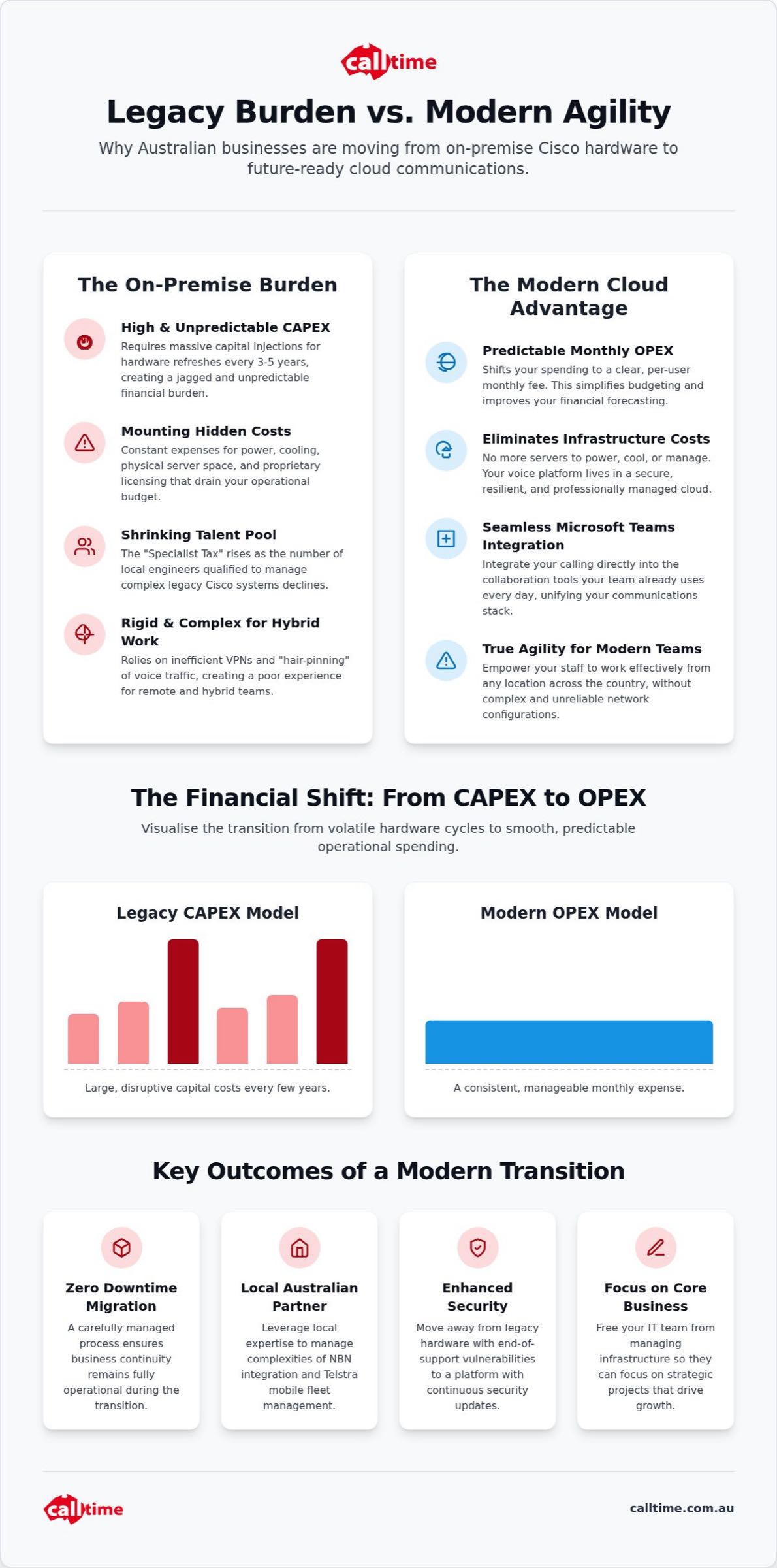
Maintaining an on-premise footprint requires a massive capital injection every five years to handle hardware refreshes. This creates a jagged, unpredictable line on your balance sheet that’s difficult for any CFO to manage. Transitioning to a Hosted PBX model shifts this burden to a predictable, per-user monthly fee. For many Australian organisations, this move from CAPEX to OPEX offers immediate tax benefits and frees up cash flow for projects that actually drive growth. If you want to see how a modern model fits your specific budget, you can explore flexible Hosted PBX solutions that scale naturally with your headcount.
Maintenance and Support Contracts
Cisco SmartNet contracts are another recurring drain on your resources. As your hardware ages past its prime, these support fees often increase, yet the risk of “End of Life” (EOL) and “End of Support” (EOS) announcements remains a constant threat. It’s like paying for a premium insurance policy on a car that’s no longer being manufactured. You’re effectively funding the past instead of investing in your company’s future. By 2026, the risk of running EOS hardware isn’t just a technical annoyance; it’s a genuine business continuity threat that can’t be ignored.
Legacy Stability vs. Modern Agility: The Hybrid Work Gap
Traditional Cisco architectures were designed for a world where every employee sat behind a desk in a physical office. This “Inside the Firewall” security model is fundamentally at odds with the modern “Zero Trust” approach required for today’s distributed teams. When your staff work from home on standard NBN connections, legacy systems often force voice traffic through a process called “hair-pinning.” This means every call must travel from the user to your head office server and then back out to the recipient. The result is unnecessary latency and jitter that degrades call quality, making professional communication a constant struggle.
Cloud-native systems eliminate this bottleneck by routing traffic through the nearest point of presence. This shift is a core reason why replace on-premise Cisco call manager infrastructure. Instead of relying on complex VPNs that frequently drop or require manual intervention, modern solutions offer native mobile integration that works seamlessly over any internet connection. It’s about removing the technical barriers that prevent your team from being productive outside the four walls of your office.
Empowering the Remote Australian Workforce
The “Work from Anywhere” culture is no longer a perk; it’s a standard expectation in Australian corporate life. While Cisco Jabber was once a viable solution, many users now find it clunky and unreliable compared to modern Hosted PBX softphones. These newer applications provide a superior user experience with intuitive interfaces and robust “Presence” features. Your team can see exactly who is available, in a meeting, or on a call without needing to navigate a labyrinth of legacy menus. This unified messaging ensures that your distributed team stays connected and responsive, regardless of their physical location.
Scalability: Adding Users in Minutes, Not Weeks
In a legacy Cisco environment, adding a new branch office or even a handful of new lines can be a project that spans weeks. It involves physical hardware provisioning, complex dial plan updates, and significant engineering time. Cloud systems flip this script. You can scale your capacity instantly during seasonal peaks or periods of rapid business growth. This drastically reduces the “Time to Value” for new setups. Whether you’re opening a new site in Brisbane or onboarding a remote team in Perth, the infrastructure is ready in minutes. You get the agility to move at the speed of your business, not the speed of your hardware refresh cycle.
Strategic Alternatives for Australian Enterprises
Deciding why replace on-premise Cisco call manager systems is the first step. Choosing the right replacement is the second. Australian organisations are expected to spend over A$33.6 billion on public cloud services in 2026, and a large portion of this is directed toward modernising voice infrastructure. There are three primary paths for businesses looking to shed their legacy CUCM clusters: moving to a fully managed Hosted PBX, integrating voice into Microsoft Teams, or using SIP Trunking to bridge the gap. Each path offers a way to escape the maintenance trap of the past decade.
The Case for Hosted PBX
For many mid-market firms, a Hosted PBX is the ‘Goldilocks’ solution. It offers a direct, feature-rich replacement for enterprise calling without the complexity of local servers. You gain access to advanced features like Ai call recording and enterprise-grade security as standard. Because the platform is Australian-hosted, you benefit from lower latency and local support that understands the specific quirks of our domestic network. It’s the most efficient way to achieve a professional voice presence without the overhead of hardware management. This strategic shift is a major reason why replace on-premise Cisco call manager environments before they become unsupportable.
Integrating with Microsoft Teams
If your team already lives in Microsoft 365, adding Microsoft Teams calling is a logical progression. You can bring ‘Carrier Grade’ voice directly into the Teams interface, allowing staff to make and receive external calls from the same app they use for internal chat. Australian IT managers must choose between Direct Routing and Operator Connect. Direct Routing often provides more flexibility for complex dial plans, while Operator Connect offers a simpler, plug-and-play experience. It’s a powerful way to consolidate your software stack and reduce the number of vendors you manage while improving mobility for your hybrid workforce.
SIP Trunking: The Bridge to the Future
Not every business is ready to scrap their existing handsets on day one. SIP Trunking allows you to extend the life of your legacy hardware while still reducing call costs. By connecting your on-premise PBX to the cloud via NBN Enterprise Ethernet, you ensure high-quality voice traffic that isn’t competing with general internet usage. This transition strategy allows you to move your lines first and your hardware later. It’s a sensible way to de-risk the migration process without sacrificing performance. If you are ready to explore these options, you can view our full range of voice solutions to find the best fit for your architecture.
Migrating from Cisco to a Hosted Environment with Calltime
Transitioning away from legacy hardware is often viewed as a daunting technical chore. We view it differently. It’s a strategic business upgrade that removes the friction of the past two decades. Our methodology ensures that the “heavy lifting” of porting numbers and reconfiguring complex call flows happens entirely behind the scenes. This is the definitive answer to why replace on-premise Cisco call manager systems: to reclaim your time and focus on growth while we act as the silent engine behind your communication. We don’t just swap out servers; we modernise your entire workflow.
The Calltime Migration Framework
Our specialists have refined a three-phase approach to ensure your transition is seamless and risk-free. We understand that communication is the lifeblood of your business, so we prioritise continuity above all else.
- Phase 1: The Audit. We conduct a deep dive into your existing Cisco configurations, dial plans, and user requirements. This ensures every critical feature is mapped to your new cloud environment.
- Phase 2: Parallel Run. We deploy your new Hosted PBX or Microsoft Teams calling solution alongside your legacy system. This strategy allows for thorough testing and ensures zero disruption to your customer calls during the switch.
- Phase 3: Go-Live and Support. Once testing is complete, we manage the final cutover. Your staff receive comprehensive training, and our Australian-based centre provides immediate support to ensure everyone is confident with the new tools.
Why a Local Partner Matters
Navigating the Australian telecommunications landscape requires local expertise. From managing NBN Enterprise Ethernet installations to optimising Telstra mobile phone plans for your fleet, we handle the regional complexities that global providers often overlook. Having a local partner means you have “boots on the ground” when you need integrated office security or CCTV setups that work in harmony with your voice network. We provide a single-bill solution that simplifies your accounts and gives you one point of contact for all your infrastructure needs.
Modernising your communications doesn’t have to be a leap into the unknown. By choosing a partner that understands both legacy Cisco architecture and modern cloud-native platforms, you ensure your business is ready for whatever 2026 and beyond may bring. Organise a consultation with Calltime to audit your Cisco setup today.
Future-Proof Your Business Communications
The shift from legacy hardware to cloud-native architecture is no longer just a technical preference; it’s a strategic necessity for Australian enterprises. By moving to a modern Hosted PBX or Microsoft Teams environment, you eliminate the mounting “Specialist Tax” and the inefficiency of “hair-pinning” voice traffic. You transform an unpredictable CAPEX burden into a streamlined, per-user OPEX model that scales alongside your growth. Understanding why replace on-premise Cisco call manager systems today ensures you aren’t left behind by aggressive end-of-support timelines or shrinking talent pools.
As an Australian-owned and operated partner, we specialise in zero-downtime migrations that integrate your NBN and mobile solutions into a single, high-performance engine. We handle the heavy lifting so your team can stay productive from any location. Upgrade your business communication with Calltime Hosted PBX and secure your transition to a modern, agile future. It’s time to let your technology work for you, not the other way around.
Frequently Asked Questions
Is Cisco Call Manager being discontinued or going End of Life?
Cisco hasn’t discontinued the platform entirely, but older versions are rapidly reaching end-of-support (EOS) status. Version 12.5 hit its EOS date in August 2025, and Version 14 is set for April 2027. This aggressive lifecycle management is a major reason why replace on-premise Cisco call manager systems now. Cisco is prioritising cloud-first development, meaning on-premise users will see fewer new features and higher support costs as legacy versions expire over the coming months.
Can I keep my existing Cisco IP phones if I move to a Hosted PBX?
Yes, many modern Cisco handsets like the 7800 and 8800 series can be repurposed for a Hosted PBX environment. These devices typically require a firmware conversion to Multiplatform Phone (MPP) software to support standard SIP protocols. While older SCCP or Skinny protocol phones might need replacing, converting your current fleet can significantly reduce the initial cost of your migration. We assess your hardware during the audit phase to determine which devices are compatible for reuse.
How long does it take to migrate from an on-premise PBX to the cloud?
A standard migration typically takes between four and eight weeks from the initial audit to the final cutover. The primary variable is the complexity of your call flows and the time required for number porting through the Australian telecommunications network. Category C ports, which involve complex multi-line sets, can take longer than simple single-line transfers. We use a parallel run strategy to ensure your business remains fully operational throughout this entire transition period without any disruption.
Will moving to a virtual phone system affect my call quality?
Moving to a virtual system often improves call quality by eliminating the latency caused by traffic hair-pinning through your head office. When your voice traffic travels directly to the cloud via a high-quality NBN connection, you reduce the risk of jitter and dropped packets. We prioritise voice traffic using Quality of Service (QoS) settings to ensure crystal-clear audio, even when your team is working from home on standard residential broadband services across the country.
What is the cost difference between CUCM maintenance and Hosted PBX?
The most significant difference is the shift from heavy capital expenditure to a predictable monthly operating expense. Maintaining an on-premise Cisco cluster involves ongoing SmartNet fees, power costs, and the expense of specialised engineering staff. In contrast, a Hosted PBX includes all maintenance, security updates, and feature upgrades in a single per-user fee. Most Australian businesses find the total cost of ownership is lower when they remove the burden of managing physical server hardware.
How does Microsoft Teams calling compare to a traditional Cisco setup?
Microsoft Teams calling offers superior integration with your existing Microsoft 365 apps, making it ideal for a hybrid workforce. While a traditional Cisco setup is a powerful voice-first platform, it often feels siloed from other collaboration tools. Teams allows your staff to manage calls, chat, and files in one interface. By using Direct Routing, you can add carrier-grade voice quality to Teams, providing the stability of a traditional PBX with modern cloud flexibility.
Do I need to upgrade my internet connection to support a cloud phone system?
Not necessarily, but your internet is now the backbone of your phone system. For small offices, a standard NBN connection is often sufficient if it has enough upload bandwidth. However, for larger sites or contact centres, we recommend NBN Enterprise Ethernet. This provides symmetrical speeds and a Service Level Agreement (SLA) that ensures your voice traffic remains stable. We audit your current connection as part of our migration framework to ensure it meets your specific requirements.
Is a Hosted PBX more secure than an on-premise Cisco server?
A Hosted PBX is often more secure because it benefits from the massive security investments made by cloud providers. On-premise servers require manual patching and are vulnerable if your local firewall or VPN isn’t perfectly configured. Cloud-native systems use a Zero Trust model and receive automatic security updates to defend against emerging threats. This removes the risk of running outdated firmware on local hardware, which is a key reason why replace on-premise Cisco call manager infrastructure.